Year of the Bounding Lamb, 5th Waning, Day 4 – The Escaped Rout Pt. II.
Ah, there is nothing like the aroma of a cool Spring morning! The crisp air invigorates the body, and the sounds of the songbirds clear away the shadows and cobwebs from a burdened soul! I have always relished greeting the sun as he first peers over the horizon, though it appears that several of my compatriots find more comfort in the embrace of their bedrolls. The only two who are awake, besides myself, are Sir Ravenmantle and Lady Proudfinger. She kneels in prayer, arms raised in supplication towards her God. She spends far more time praising her God and interceding for others than I would think necessary; certainly more than any other novitiate I've known. It seems to work for her, though, and her demeanor can be like a soothing balm after a hard day. Sir Ravenmantle certainly appreciates it. He's supposed to be keeping the final watch of the night for the whole camp, but I suspect were we to fall under attack, his priority would be to protect the holy woman. It's natural, I suppose; I believe they were traveling together before they fell in with the doomed militia.
Hmmm... I should probably be memorizing spells, but my mind is still awhirl with the events of the previous day. So While my friends slumber, I'm glad to take this opportunity resume my account of the yesterday's madness, in hopes that doing so will give rest to my troubled thoughts.

Wednesday, April 21, 2010

Thursday, April 15, 2010
When HP are not physical damage
Everyone's been there. Your fighter is going toe-to-toe with an orc/ogre/owlbear/whatever. You hack him for 10 HP, he rakes you for 12, you chop at him for 7, he bites you for 3, and on and on. You trade blows back and forth until that magic moment when your hero goes from 1 HP to 0 (or fewer, depending on edition) HP. Last round he was fighting in top physical condition, now he's wormfood.
This rather jarring transition has always bothered me. If HP represents physical integrity or health, then the loss of HP would seem to suggest strongly a concurrent loss of physical capacity of some sort. But that's never the case. Even with systems that use the "death due to massive damage" rule, if you make your save, the character suffers no ill effects. This is unsatisfying to both sides of my brain. The left hemisphere recoils at the idea of a warrior who accumulates vague, unsourced bloodstains on his armor, all the while slashing with gusto, until he just croaks cartoon-style. It's nonsensical. The right hemisphere pipes up that's also booooring.
The problem is that if you get rid of HP, and you go to a more realistic injury system, you're going to be rolling up new characters every other encounter. Not just due to PC death; even relatively minor injuries would realistically sideline an adventurer for days or weeks. It can be fun to play with that level of lethality, and it works well in games such as Call of Cthulhu. In our group's most recent session, an apparition of an elder god clawed at one of our investigators, raking him for 10 of his 12 HP. The guy was able to get off a wild gunshot, but was then down for the count. He survived, but was in the hospital for most of the rest of the game. But usually, particularly for more pulp fantasy games like D&D, I prefer to have more of a chance to know and develop my characters. So we need some kind of buffer between Full Health and Out of Commission.
I've recently been playing Labyrinth Lord using versions of a "Death and Dismemberment" house rule. Other, slightly tweaked variants are here and here. This house rule envisions HP as an abstraction for some combination of stamina, defensive ability, determination, luck etc. When this collective store is exhausted, the character is at 0 HP, and must roll on the table to see what the consequences are:
Each time character at 0 HP takes "damage", he must roll again on the table. This is the best way I've seen to model the fact that until someone takes actual physical damage, they are more or less at full capacity. But once they are injured, things get bad in a hurry, as each further injury brings a chance of disaster.
If you haven't tried gaming this way before, I'd highly recommend it.
This rather jarring transition has always bothered me. If HP represents physical integrity or health, then the loss of HP would seem to suggest strongly a concurrent loss of physical capacity of some sort. But that's never the case. Even with systems that use the "death due to massive damage" rule, if you make your save, the character suffers no ill effects. This is unsatisfying to both sides of my brain. The left hemisphere recoils at the idea of a warrior who accumulates vague, unsourced bloodstains on his armor, all the while slashing with gusto, until he just croaks cartoon-style. It's nonsensical. The right hemisphere pipes up that's also booooring.
The problem is that if you get rid of HP, and you go to a more realistic injury system, you're going to be rolling up new characters every other encounter. Not just due to PC death; even relatively minor injuries would realistically sideline an adventurer for days or weeks. It can be fun to play with that level of lethality, and it works well in games such as Call of Cthulhu. In our group's most recent session, an apparition of an elder god clawed at one of our investigators, raking him for 10 of his 12 HP. The guy was able to get off a wild gunshot, but was then down for the count. He survived, but was in the hospital for most of the rest of the game. But usually, particularly for more pulp fantasy games like D&D, I prefer to have more of a chance to know and develop my characters. So we need some kind of buffer between Full Health and Out of Commission.
I've recently been playing Labyrinth Lord using versions of a "Death and Dismemberment" house rule. Other, slightly tweaked variants are here and here. This house rule envisions HP as an abstraction for some combination of stamina, defensive ability, determination, luck etc. When this collective store is exhausted, the character is at 0 HP, and must roll on the table to see what the consequences are:
| 2d6 | RESULTS |
| 2 or lower | Instant Death (decapitated or similar death from CtB). |
| 3 | Fatal Wound (gutted, stabbed through lung, broken back, and the like) die in 1d20 x 10 minutes. A Wish or similar effect would heal wound. Knocked Out until death unless Save vs Death is made. |
| 4-5 | Severed Limb use hit location die, if head rolled and no helmet then as '2', if body rolled and no armor then as '3', otherwise will bleed out and die in 1d6 rounds. Magical healing (magic used for this will not restore lost hp), a tourniquet, or cauterization with fire will allow a Save vs Death with bonus equal to lvl of spell cast, if any. Success means character requires 3d4 weeks of healing. Knocked Out until death unless Save vs Death is made. |
| 6-7 | Broken Bone use hit location die. 3d4 weeks to heal. Knocked Out 1d20 rounds unless Save vs Death is made. If head bone was broke and no helmet and failed save then knocked out, "in coma", until healed instead. |
| 8-9 | Knocked Out for 1d12 rounds if wearing a helm. If no helmet then as Broken Head Bone. |
| 10-11 | Stunned for 1d4 rounds and lose helm if wearing helm. Knocked Out for 1d12 rounds if not wearing helm. |
| 12+ | "Now I'm Mad" a surge of adrenaline returns 1d4 hit points per hit die. At the end of the combat, the adrenaline drains away, hit points are reduced to zero, and the PC faints for 2d6 rounds. If you roll this more than once in a single combat consider yourself a Berserker under the effects of a potion of super-heroism. |
Each time character at 0 HP takes "damage", he must roll again on the table. This is the best way I've seen to model the fact that until someone takes actual physical damage, they are more or less at full capacity. But once they are injured, things get bad in a hurry, as each further injury brings a chance of disaster.
If you haven't tried gaming this way before, I'd highly recommend it.
Tuesday, April 13, 2010
New Kids in the Sandbox
Norm over at Troll and Flame asks whether new DMs and new players can handle running or playing in a sandbox style campaign. Having never run a sandbox campaign, I can only speculate how a new DM would fare. Being an ultra-planner, I personally would not feel comfortable DM-ing unless I had done quite a lot of the work ahead of time. This may be due in part to the fact that the only systems I've DMed are D&D 3.5 and Mutants and Masterminds, both of which are on the rules-heavy end of the spectrum.
As a player, I feel that little experience is necessary to enjoy a sandbox campaign. For even the greenest tenderfoot, a short briefing by the DM should suffice. Here's an example:
As a player, I feel that little experience is necessary to enjoy a sandbox campaign. For even the greenest tenderfoot, a short briefing by the DM should suffice. Here's an example:
Wednesday, April 7, 2010
B2 Caves of Chaos Marathon - Player's Perspective
This Saturday April 3rd, I played in my first ever marathon session of gaming. 11:00 AM to 11:00 PM, a full 12 hours of gaming interrupted only briefly to address various gastrointestinal imperatives. I'd heard stories of people embarking on long stretches of adventuring such as this, but having missed out on tabletop gaming as a kid, I never had the opportunity to try it myself. So when the chance came to go the distance on a return to the Caves of Chaos, I grabbed it.

At this point, you should go over to the Troll and Flame blog to read the first part of the game writeup. Norm, who ran the previous Caves of Chaos session, was back in the DM's chair for this game. The first part of this post will address some of the issues/questions he raises.
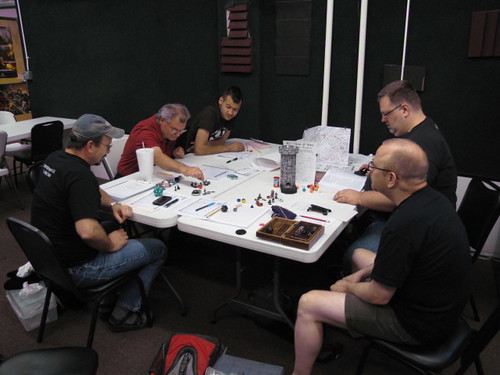
At this point, you should go over to the Troll and Flame blog to read the first part of the game writeup. Norm, who ran the previous Caves of Chaos session, was back in the DM's chair for this game. The first part of this post will address some of the issues/questions he raises.
Tuesday, April 6, 2010
Call of Cthulhu Campaign Chronicle #1

Character Generation
I really got a kick out of creating my character, "Mike McTigue". Rolling up a "normal" guy was actually something of a treat and a welcome change from making medieval superheroes for D&D. The game is set in the 1920's, and Mike is a former rising star in the pro-boxing circuit. Unfortunately, his passion for betting on the ponies led to a run-in with an angry bookie over debts he couldn't pay. The mob decided to insist on payment in the classic mob fashion, and Mike's resulting broken leg left him with a pronounced limp. This spelled the end for his boxing ccareer, and might have been the end of Mike if his former trainer, Salvatore Finazzi, hadn't taken pity on him. Sal knew some people at Miskatonic U., and was able to find Mike a job there as a librarian. Mike had become engrossed in literature during his convalescence; next to boxing, books were his great passion.
At my first game, two other players showed up out of a possible four. The two missing PCs were a bootlegger and a veteran/student. The two that did play were:
Louise - A flapper with a taste for the sauce, and who's not above using her feminine wiles to get her way.
Parker - A government agent posing as a psychology student. She carries a gun in her purse, and a combination armory/hardware store in the trunk of her car.
Friday, March 26, 2010
Twingol's Tales: Aurora Campaign Chronicle #1
Other than the B2 Caves of Chaos one-shot, the most recent game session for my D&D group marked the beginning a new campaign, as we unwrapped new characters for adventures in the land of “Aurora”.
What follows is the first installment of a campaign chronicle, written as the personal journal of one of my characters: Twingol the Gnome Illusionist. The account was composed a week or two after the actual session, so I’ve used creative license to fill gaps in my recollection, as well as to punch up the narrative. An example of the latter would be Twingol’s reference to “Foundry Day”, an event which marks the first day a young dwarf is deemed eligible to work as a blacksmith unsupervised. Think of it as something of a Dwarven “Sweet 16”, a day of celebration for the normally dour race, and one of much, much drinking.
[edit: When I first made this post, I was having trouble recalling all of the names of the characters. Consequently, I was forced make numerous references to "the other gnome wizard", which is a very clunky and unsatisfying way of identifying a subject. So in a bit of post ret-conning, here is the cast of characters:
Oliver: DM
Frank:
Montgomery Drake Scott, Esquire - Human Cavalier
Zeb (no clan name given) - Gnome Thief/Mage
Todd:
Jane Proudfinger - Human Cleric
Gareth Ravenmantle - Gnome Paladin
Flip(me):
Beorn Sigrunsen - Human Barbarian
Twingol "Twinkle" Fiddlesap, Image Master Red Class - Gnome Illusionist (Image Maker kit)]
What follows is the first installment of a campaign chronicle, written as the personal journal of one of my characters: Twingol the Gnome Illusionist. The account was composed a week or two after the actual session, so I’ve used creative license to fill gaps in my recollection, as well as to punch up the narrative. An example of the latter would be Twingol’s reference to “Foundry Day”, an event which marks the first day a young dwarf is deemed eligible to work as a blacksmith unsupervised. Think of it as something of a Dwarven “Sweet 16”, a day of celebration for the normally dour race, and one of much, much drinking.
[edit: When I first made this post, I was having trouble recalling all of the names of the characters. Consequently, I was forced make numerous references to "the other gnome wizard", which is a very clunky and unsatisfying way of identifying a subject. So in a bit of post ret-conning, here is the cast of characters:
Oliver: DM
Frank:
Montgomery Drake Scott, Esquire - Human Cavalier
Zeb (no clan name given) - Gnome Thief/Mage
Todd:
Jane Proudfinger - Human Cleric
Gareth Ravenmantle - Gnome Paladin
Flip(me):
Beorn Sigrunsen - Human Barbarian
Twingol "Twinkle" Fiddlesap, Image Master Red Class - Gnome Illusionist (Image Maker kit)]
Thursday, March 25, 2010
Juggling Worlds

As I've mentioned before, I'm currently playing in three different 1e/2e campaigns. Essentially, my D&D group rotates between three different sets of PCs in three different game worlds directed by three different DMs. In addition, others will occasionally run one-shot games, sometimes with an existing particular combination of PCs and World, other times with a completely new cast, location, or even game system. We settled on this arrangement because we are blessed (or cursed) with a surfeit of DMs, none of whom really have the time to devote to the preparations a regular game would require. The end effect is that a given DM may go a month or more between running a session; during which interval he is reduced to the lowly status of player in the games of the other DMs.
Each regular player in each campaign typically rolls up 2 PCs to play, giving a total of 8 active characters. This allows us to accommodate those players who are only able to attend sessions infrequently, as well as curious passers-by who want to try out the game. The guest player will assume control of an absent regular's PCs, or one of the attending regulars will loan him one of theirs.
As you might expect, this jumble of worlds and players can lead to a bit of confusion -
Tuesday, March 23, 2010
The old made new again: TARGA and Labyrinth Lord
This week is International Traditional Gaming Week, and in observation, the Austin D&D Meetup group featured a one-shot of the B2 Caves of Chaos module. Our system of choice: Labyrinth Lord, a "retro-clone" of the Dungeons and Dragons Basic Set.

Our group was made up of mostly of old-school players, several of whom had fond memories of B2 from their dusty gaming past, but we also had a couple of players, including myself, who broke into the hobby w/ the later editions. So for me, the anticipation was two-fold: 1st, that I was going to get to play an edition I'd never touched before, and one that has drawn rave reviews from the "Old School Renaissance" (OSR) community. 2nd, in playing B2 itself, I felt almost like I would be undergoing something of a Rite of Passage for gamers, the kind of a shared experience that unites a community of like-minded folk, and gives them a basis for communication.
This was in addition to my typical eagerness for any chance to game. So what did this new-school player think of old-school play? Read on, fellow traveler...

Our group was made up of mostly of old-school players, several of whom had fond memories of B2 from their dusty gaming past, but we also had a couple of players, including myself, who broke into the hobby w/ the later editions. So for me, the anticipation was two-fold: 1st, that I was going to get to play an edition I'd never touched before, and one that has drawn rave reviews from the "Old School Renaissance" (OSR) community. 2nd, in playing B2 itself, I felt almost like I would be undergoing something of a Rite of Passage for gamers, the kind of a shared experience that unites a community of like-minded folk, and gives them a basis for communication.
This was in addition to my typical eagerness for any chance to game. So what did this new-school player think of old-school play? Read on, fellow traveler...
Saturday, March 20, 2010
Jozan come lately
[To better understand my perspective on games, it might be useful to know a little history about me. I apologize in advance if these preliminary "throat-clearing" posts are boring, but I can't seem to get started without organizing my thoughts this way. Please feel free to skip ahead if you like.]
I'm a relative latecomer to tabletop RPGs, having only started playing about four years ago. I had wanted to play for a long time, but various factors prevented it. Probably the greatest obstacles were:
1) In the 80s, for those of us who grew up in Christian environments, playing D&D was considered a hop, skip and a jump away from sacrificing virgins to Satan himself. My parents knew such a thing had no place in a good Baptist family like ours. They let me know in such stark terms, I never even asked for the game. I didn't personally feel that playing would make me start painting pentagrams on the floor with the blood of a black goat, but I was a good kid who minded his parents.
2) Apart from the religious condemnation of RPGs, the social stigma attached to those who played D&D and other games remained strong. So even when I felt more freedom in college, and when churches weren't quite so preoccupied with the dangers of D&D, I still stayed away. Call it a lack of self-esteem or self-confidence, but I actually was worried if playing RPGs would hurt my chances with the ladies. In my mind, it was bad enough that I played scifi/fantasy video games and read scifi/fantasy novels, actually pretending to be a wizard myself would be too much of a risk for my social life.
So fast foward a few more years to when I'm married. My wife has a few quirks of her own, and in a lot of ways doesn't feel bound to convention. She knows I like fantasy books and games, so when I ran across an announcement for a D&D 3.5ed one shot game through the local RPG Meetup group, she actually encouraged me to go.
I went, and I loved it.
We didn't get very far that day, as the DM (Norm, of Troll and Flame fame) had to walk me through character creation, and I'm sure I annoyed the other players with my constant questions. But it was a ton of fun anyway. I still recall how our entire party nearly got wiped out by a few flame-breathing kobolds. They were sitting at the top of a tall makeshift barricade made from the piled remains of broken furniture and other trash, and I could not make a Climb check to reach the buggers to save my life.
So now I've been bitten by the RP bug, and I'm trying to play catch up for all the years of gaming I've missed. I've played in a D&D 3.5e campaign, and have played one shots of Savage Worlds, Tunnels and Trolls, Mutants and Masterminds, and Warhammer Fantasy Roleplay. I'm currently playing in 3, yes 3, rotating D&D hybrid 1e/2e campaigns. Because that's not enough, I've got couple of Labyrinth Lord one shots lined up, and I'm joining another group playing Call of Cthuhlu.
In the posts to come, I'll give a more complete recount of each gaming experience. I plan both to blog about what I recall of my older games, and also give a comprehensive overview of my current games. I'll use these as a base to explore the mechanics, styles and flavors of the different systems, as well as the experiences they produce.
I'm a relative latecomer to tabletop RPGs, having only started playing about four years ago. I had wanted to play for a long time, but various factors prevented it. Probably the greatest obstacles were:
1) In the 80s, for those of us who grew up in Christian environments, playing D&D was considered a hop, skip and a jump away from sacrificing virgins to Satan himself. My parents knew such a thing had no place in a good Baptist family like ours. They let me know in such stark terms, I never even asked for the game. I didn't personally feel that playing would make me start painting pentagrams on the floor with the blood of a black goat, but I was a good kid who minded his parents.
2) Apart from the religious condemnation of RPGs, the social stigma attached to those who played D&D and other games remained strong. So even when I felt more freedom in college, and when churches weren't quite so preoccupied with the dangers of D&D, I still stayed away. Call it a lack of self-esteem or self-confidence, but I actually was worried if playing RPGs would hurt my chances with the ladies. In my mind, it was bad enough that I played scifi/fantasy video games and read scifi/fantasy novels, actually pretending to be a wizard myself would be too much of a risk for my social life.
So fast foward a few more years to when I'm married. My wife has a few quirks of her own, and in a lot of ways doesn't feel bound to convention. She knows I like fantasy books and games, so when I ran across an announcement for a D&D 3.5ed one shot game through the local RPG Meetup group, she actually encouraged me to go.
I went, and I loved it.
We didn't get very far that day, as the DM (Norm, of Troll and Flame fame) had to walk me through character creation, and I'm sure I annoyed the other players with my constant questions. But it was a ton of fun anyway. I still recall how our entire party nearly got wiped out by a few flame-breathing kobolds. They were sitting at the top of a tall makeshift barricade made from the piled remains of broken furniture and other trash, and I could not make a Climb check to reach the buggers to save my life.
So now I've been bitten by the RP bug, and I'm trying to play catch up for all the years of gaming I've missed. I've played in a D&D 3.5e campaign, and have played one shots of Savage Worlds, Tunnels and Trolls, Mutants and Masterminds, and Warhammer Fantasy Roleplay. I'm currently playing in 3, yes 3, rotating D&D hybrid 1e/2e campaigns. Because that's not enough, I've got couple of Labyrinth Lord one shots lined up, and I'm joining another group playing Call of Cthuhlu.
In the posts to come, I'll give a more complete recount of each gaming experience. I plan both to blog about what I recall of my older games, and also give a comprehensive overview of my current games. I'll use these as a base to explore the mechanics, styles and flavors of the different systems, as well as the experiences they produce.
Wednesday, March 17, 2010
Post, the first
Socrates said "The unexamined life is not worth living." Perhaps a tad hyperbolic, but his point is well taken. I'll modify that point, and offer this paraphrase: "The unexamined game is not worth playing." Again, hyperbole, but essentially, while it's perfectly fine and enjoyable to plop down and roll some dice, killing non-existent monsters and stealing their imaginary loot, you leave a lot of fun on the table if that's all you ever do.
But how to examine one's game? Unfortunately, I find I never know what I really feel/believe/know until I've written it down. I can't truly test my thoughts and beliefs until I'm forced to translate them into words on paper (or the screen). This process often reveals innumerable inconsistencies and errors which must each be dealt with before I'm satisfied, even if it means scrapping the whole thing and starting over. It makes for achingly slow writing, but I think (hope) the end product is the better for it.
Hence, this blog.
In addition to tabletop gaming stuff, focused mostly on what I'm currently playing, I'll occasionally throw in other items of geekery to break things up a bit. I'll try to keep things interesting and/or informative, and at least honest.
But how to examine one's game? Unfortunately, I find I never know what I really feel/believe/know until I've written it down. I can't truly test my thoughts and beliefs until I'm forced to translate them into words on paper (or the screen). This process often reveals innumerable inconsistencies and errors which must each be dealt with before I'm satisfied, even if it means scrapping the whole thing and starting over. It makes for achingly slow writing, but I think (hope) the end product is the better for it.
Hence, this blog.
In addition to tabletop gaming stuff, focused mostly on what I'm currently playing, I'll occasionally throw in other items of geekery to break things up a bit. I'll try to keep things interesting and/or informative, and at least honest.
Subscribe to:
Posts (Atom)